
- Top
- Sustainability at Nihon Dengi
- For the Global Environment
For the Global Environment

Based on our recognition that the Group’s business activities can contribute directly to global environmental conservation, we will actively develop our business and contribute to the creation of a carbon-neutral and recycling-oriented society by reducing CO2 emissions that exacerbate climate change and by working on energy-saving and resource-saving solutions through instrumentation engineering.
Strategies
The Group conducted a scenario analysis in line with the recommendations of the Task Force on Climate-related Financial Disclosures (TCFD) to identify risks and opportunities related to climate change in the value chain of each business segment, and to evaluate business impacts and formulate countermeasures. Each of the Group’s business segments, the air conditioning instrumentation-related business and the industrial systems-related business, followed the steps shown below to conduct the scenario analysis.
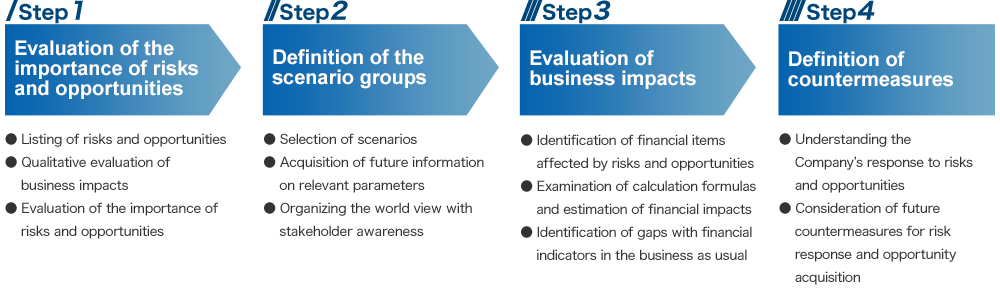
Scenario analysis
The Group chose the scenario of limiting the global average temperature rise to less than 1.5°C compared to pre-industrial levels in line with the framework of the Paris Agreement, and the 4°C scenario that predicts that global warming will progress without intervention. Under each scenario, transition risks related to policies, regulations, and market trends, and physical risks from natural disasters, etc. were analyzed.
| Description of worldview | Reference scenario | |
|---|---|---|
| 1.5°C scenario | A scenario that significantly reduces greenhouse gas emissions, rapidly advances the transition toward decarbonization, and mitigates the rise in temperatures |
From the International Energy Agency (IEA)’s transition scenarios
From the Intergovernmental Panel on Climate Change (IPCC)
|
| 4°C scenario | A scenario in which emissions are not reduced sufficiently, leading to continued temperature rise and a worsening of climate-related disasters and physical impacts |
From the International Energy Agency (IEA)’s transition scenarios
From the Intergovernmental Panel on Climate Change (IPCC)
|
Results of scenario analysis
The results of the Group’s scenario analysis are as follows. The financial impacts were also quantitatively estimated and qualitatively assessed. The criteria for quantitative and qualitative assessments are defined.
Note that, based on the emission volumes for each Scope as shown below, the Group does not have an energy consumption of reportable level (crude oil equivalent of 1,500 kL) under the Act on the Rational Use of Energy. As the volumes of Scope 1 and Scope 2 emissions are not large, the Group recognizes that the climate change-related risks are relatively low.
In addition, through the scenario analysis, it became clear that the air conditioning instrumentation-related business affects the energy consumption of customers, and that the expansion of this business segment, which centers on energy conservation proposals, represents a major business opportunity.
Risk and opportunity
| Classification | Item | Overview | Risk/ Opportunity |
1.5°C scenario |
4°C scenario |
Countermeasure | |||||
|---|---|---|---|---|---|---|---|---|---|---|---|
| Short -term |
Medium -term |
Long -term |
Short -term |
Medium -term |
Long -term |
||||||
| 2027 | 2030 | 2050 | 2027 | 2030 | 2050 | ||||||
| Transition | Policy and law |
Increase in operational costs due to energy prices and the introduction of carbon pricing |
|
Risk |

|

|
|
|
|
|
|
| Increase in order opportunities through the use of subsidies from national and local governments |
|
Opportunity | Medium | Medium |
|
||||||
| Technology market |
Risk of opportunity loss in acquiring new markets due to insufficient technical capabilities |
|
Risk | Large | Large |
|
|||||
| Market | Increase in demand and expansion of opportunities to provide ZEB and environmental solutions |
|
Opportunity |

|
|
|

|
|
ー |
|
|
| Reputation | Increase in financing costs due to insufficient information disclosure and unmet targets |
|
Risk | Small | Small |
|
|||||
| Physical | Chronicity | Reduction in workforce and decrease in productivity due to deteriorating working conditions (such as heatstroke) |
|
Risk | ー | ー | ー | ー |
|
|
|
| Supply shortages due to supplier shutdowns and transportation delays |
|
Risk | Large | Large |
|
||||||
| Increase in orders for disaster response, BCP measures, and resilience solutions |
|
Opportunity | Medium | Medium |
|
||||||
| Acuity | Natural disaster |
|
Risk |

|
|
|
|
|
|
|
|
Criteria for quantitative and qualitative assessments
| Impact level | Qualitative | Risk | Opportunity | Quantitative |
|---|---|---|---|---|
| Large | Risks that could have a significant impact on the continuation of the business Opportunities that could have a significant impact on the expansion of the business |
|
|
Those with a financial impact of ¥1,000 million or more |
| Medium | Risks that could have a moderate impact on the continuation of the business Opportunities that could have a moderate impact on the expansion of the business |
|

|
Those with a financial impact of ¥100 million to ¥1,000 million |
| Small | Risks that could have a minor impact on the continuation of the business Opportunities that could have a minor impact on the expansion of the business |
|
|
Those with a financial impact of less than ¥100 million |
Reference information
Indicators and targets
The Group’s greenhouse gas emissions (Scopes 1, 2, and 3) are as follows. The Group has set CO2 reduction targets and received SBT certification in May 2026.
CO2 reduction targets for FY2031/3 (compared to FY2024/3)
| Scopes 1 and 2 | (42.0)% |
|---|---|
| Scope 3 | (25.0)% |
(Unit: t-CO2)
| FY2024/3 | FY2025/3 | FY2026/3 | |||
|---|---|---|---|---|---|
| Scope 1 | 650 | 630 | 589 | ||
| Scope 2 (location-based) | 544 | 556 | 571 | ||
| Scope 2 (market-based) | 573 | 614 | 2 | ||
| Scope 3 | Category 1 | Purchased goods and services | 25,292 | 28,435 | 20,120 |
| Category 2 | Capital goods | 1,008 | 1,734 | 1,642 | |
| Category 3 | Fuel- and energy-related activities (not included in Scope 1 or Scope 2) |
237 | 241 | 265 | |
| Category 4 | Upstream transportation and distribution | 1,553 | 1,782 | 1,668 | |
| Category 5 | Waste generated in operations | 126 | 100 | 138 | |
| Category 6 | Business travel | 554 | 538 | 785 | |
| Category 7 | Employee commuting | 325 | 396 | 436 | |
| Category 9 | Downstream transportation and distribution | 132 | 208 | 173 | |
| Category 11 | Use of sold products | 150,815 | 111,145 | 95,788 | |
| Category 12 | End-of-life treatment of sold products | 24 | 28 | 18 | |
| Scope 3 total | 180,065 | 144,607 | 121,033 | ||
| Grand total (location-based) | 181,259 | 145,793 | 122,193 | ||
| Grand total (market-based) | 181,288 | 145,851 | 121,623 | ||
(Notes)
- Calculations of Scopes 1, 2, and 3 for FY2024/3 and FY2025/3 include the Company and its consolidated subsidiary Jupiter Advanced Systems Co., Ltd.
- Calculations of Scopes 1, 2, and 3 for FY2026/3 include the Company, its consolidated subsidiary Jupiter Advanced Systems Co., Ltd., and its non-consolidated subsidiaries ND Tech Co., Ltd. and ND Tech Services Co., Ltd.
- The Group has obtained third-party assurance for GHG emissions for FY2024/3, FY2025/3, and FY2026/3.
Third-party assurance
The Group is committed to enhancing the reliability of our greenhouse gas emissions data. To achieve this, we conduct third-party verifications on an annual basis and receive an independent assurance statement from BSI Group Japan K.K., the verifying body. Through this process, we aim to provide our stakeholders with more reliable and transparent data disclosures.
We have conducted a third-party verification of our greenhouse gas emissions data for the fiscal year ended March 31, 2026 based on the international standard ISO 14064-3:2019 and have received an independent assurance statement.
